
How to Open a Salon or Barbershop in Oman (Licensing, Costs & Full Setup Guide 2026)
WAJ Team
July 8, 2026
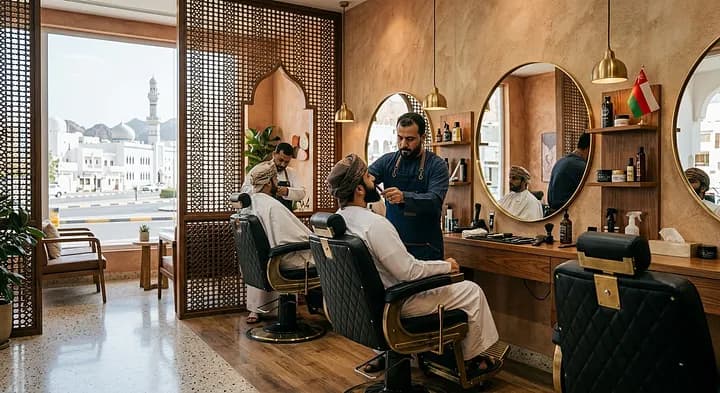
1. Oman's Beauty & Grooming Market: Strategic Context
Oman's personal care and beauty services industry is undergoing steady growth, supported by government-led economic diversification under Oman Vision 2040. The Sultanate's SME development agenda, administered through the Small and Medium Enterprises Development Authority (SMEDA), actively encourages entrepreneurship in service sectors including beauty, wellness, and personal care.
Market observations indicate that Muscat — as the capital and primary commercial hub — represents the largest concentration of demand for professional salon services. Secondary cities including Salalah, Sohar, Nizwa, and Sur present emerging opportunities as infrastructure investment drives urbanization across the Sultanate.
On average, well-positioned salons in Muscat report monthly revenues ranging from OMR 1,500 to OMR 8,000+ depending on format, service range, and client base. The Omani consumer demographic is notable for its preference for quality service experiences, and a growing expatriate population across key industrial zones sustains consistent demand for barbershop and grooming services.
Oman Beauty Market Demand Drivers
• Vision 2040 economic diversification creating SME-supportive business environment
• Growing urban population in Muscat Metropolitan Area and secondary cities
• Large expatriate workforce in industrial zones (Sohar, Duqm) driving grooming service demand
• Tourism growth — particularly in Muscat, Salalah, and Nizwa — creating demand for hotel-adjacent and tourist-accessible services
• Rising female workforce participation increasing demand for professional beauty services
• Youth demographic (median age approximately 26) embracing grooming culture
Premium vs Neighborhood Positioning in Oman
The Omani salon market supports two primary formats: premium boutique establishments in Muscat's upscale commercial districts (Al Khuwair, Qurum, Al Mouj, Madinat Al Sultan Qaboos) and neighborhood-format salons and barbershops serving residential communities. Average revenue per visit in premium Muscat locations ranges from OMR 8–25, compared to OMR 3–10 in neighborhood formats.
2. Legal Registration & Licensing Process in Oman
Oman's business registration framework is administered through the Ministry of Commerce, Industry and Investment Promotion (MOCIIP), operating via the Invest Easy portal. The process has been substantially streamlined in recent years as part of the government's business environment improvement agenda.
Step 1: Commercial Registration via Invest Easy Portal
The Invest Easy portal (investeasy.gov.om) is Oman's central online business registration platform. All new businesses must register through this system.
1. Select the appropriate business activity under the personal care / beauty services category
2. Choose your legal structure: Sole Proprietorship (for Omani nationals), Limited Liability Company (LLC), or branch of a foreign company
3. Register your trade name — must be unique and comply with MOCIIP naming conventions
4. Submit required documentation: civil ID (for nationals) or residency documents (for expatriates with appropriate visa category)
5. Pay commercial registration fees (typically OMR 150–400 depending on structure and activity)
6. Receive Commercial Registration Certificate (CR) upon approval
Step 2: Municipality Approval (Permit to Operate)
In addition to the commercial registration, salon businesses must obtain a Municipality Permit from the relevant Governorate municipality (e.g., Muscat Municipality for the Capital Area). This requires:
7. Submission of signed lease agreement for the business premises
8. Building layout plan showing compliance with health and safety requirements
9. Physical inspection by municipality health and licensing officers
10. Compliance with ventilation, plumbing, and hygiene standards specific to personal care premises
11. Fire safety compliance certificate from the Royal Oman Police (Civil Defense)
Step 3: Omanisation Compliance
The Omani government mandates a minimum proportion of Omani national employees in all businesses — a policy known as Omanisation. The applicable quota for salon businesses falls within the personal services sector classification. Non-compliant businesses face fines, renewal restrictions, and potential suspension of work permits for expatriate staff.
Many salon operators in Oman address Omanisation requirements by placing Omani nationals in managerial, administrative, reception, or retail roles, while technical positions are filled by experienced expatriate professionals from countries with established grooming traditions.
Step 4: Tax Registration
Oman introduced Value Added Tax (VAT) at 5% in April 2021, administered by the Tax Authority of Oman (formerly Oman Tax Authority). Businesses with annual taxable supplies exceeding OMR 38,500 must register for VAT. The relatively low VAT rate (5%) compared to GCC neighbors reduces the compliance burden for smaller salon operators.
Step 5: Additional Permits & Professional Certifications
• Health certificate for all staff — issued by accredited medical centres and renewed annually
• Professional qualifications for therapists performing specialized treatments (recommended)
• Signage permit from the municipality for external branding
• Trade Name Certificate (part of CR process but separately displayed)
3. Location Strategy for Oman Salon Businesses
Muscat: Primary Market
Salon setup in Muscat requires understanding the city's residential-commercial structure. High-performing salon locations include Al Khuwair (government offices and professional workforce), Qurum (commercial and residential mix), Al Mouj (premium compound and marina district), Madinat Al Sultan Qaboos (established high-income residential area), and Ruwi (high foot traffic commercial zone). Mall-based locations in City Centre Muscat and Muscat Grand Mall provide high visibility but command premium rents.
Secondary Cities: Emerging Opportunities
• Salalah: Tourism-driven demand; seasonal opportunity during Khareef festival period
• Sohar: Industrial zone workforce creates consistent male grooming demand
• Sur: Established residential community with limited competition
• Nizwa: Growing regional hub with expanding middle-class consumer base
Location Evaluation Framework
• Foot traffic volume during peak hours (8am–10am, 4pm–8pm)
• Parking availability — essential in Muscat where public transport is limited
• Competition density — mapping all existing salons within 500m radius
• Lease terms and escalation clauses in the rental agreement
• Proximity to residential catchment area or target workforce demographic
4. Startup Cost Breakdown: Salon Business in Oman
The following cost planning model reflects realistic investment ranges for a mid-size salon or barbershop in Muscat. Costs in secondary cities are typically 20–35% lower.
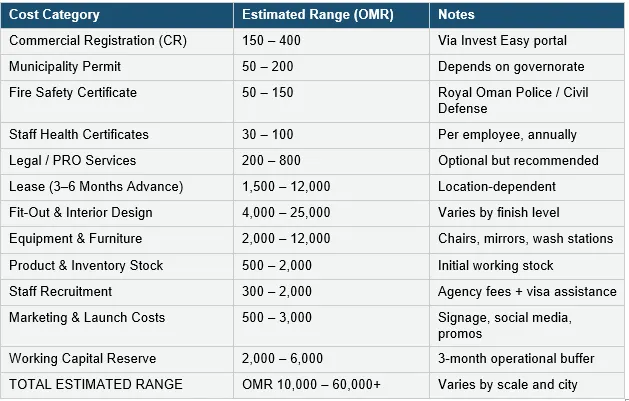
Market observations suggest that Oman presents a more accessible entry point for salon investment compared to neighboring Gulf markets, particularly for neighborhood-format operators. However, undercapitalization remains a risk — operators should ensure working capital covers at least 90 days of operations before projected break-even.
5. Interior Requirements & Equipment Checklist
Premises & Interior Requirements
• Minimum floor area: 30–50 sqm for barbershop; 60–120+ sqm for full-service salon
• Adequate ventilation system meeting Muscat Municipality health standards
• Dedicated wash area, treatment zones, and waiting area separation
• Non-slip flooring in wet treatment areas (regulatory requirement)
• Compliant fire safety installations: smoke detectors, fire extinguishers, emergency exits
Equipment Checklist
12. Barber/styling chairs (hydraulic, adjustable)
13. Shampoo stations / hair wash basins
14. Styling stations with mirrors and integrated storage
15. Hair dryers, curling tools, and straightening equipment
16. Clippers, trimmers, and blades (for barbershop operations)
17. Sterilization equipment (UV sterilizers for tools)
18. Reception desk with POS system
19. Waiting area furniture
20. Product retail display and storage units
6. Hiring Strategy for Oman Salon Operations
Role
Recommended Number
Hiring Source
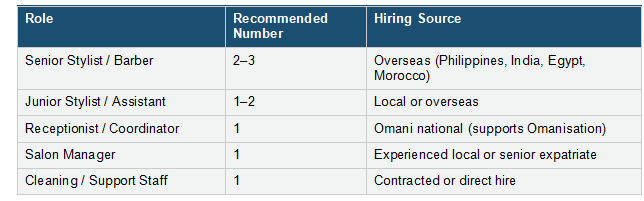
Overseas staff recruitment in Oman typically requires coordination with MOCIIP for visa quota allocation and approval. On average, the full visa and onboarding process takes 60–90 days. Work permit fees and medical examination costs for expatriate staff typically add OMR 200–500 per hire to recruitment costs.
7. Health & Safety Compliance in Oman
• All staff must hold valid annual health certificates from accredited medical facilities
• Tools must be sterilized using municipality-approved methods between clients
• Single-use disposables (razors, gloves, neck strips) must be standard practice
• Chemical products must comply with Oman's consumer safety regulations
• Premise hygiene is subject to periodic unannounced inspections by Muscat Municipality
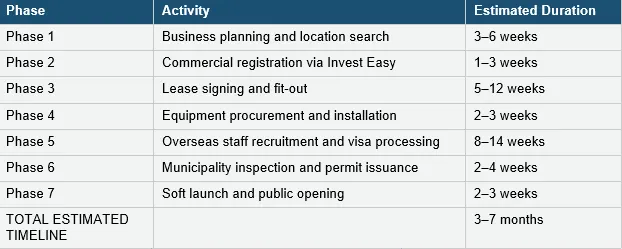
8. Expected Setup Timeline for Oman
9. Common Failure Points to Avoid in the Omani Market
• Selecting a location based primarily on rent without traffic or demographic validation
• Underestimating Omanisation quota requirements and failing to plan staffing structure accordingly
• Launching without adequate working capital — secondary cities may have slower ramp-up periods
• Relying on walk-in traffic without a structured appointment management system
• Hiring unqualified staff due to visa cost pressure, leading to poor service quality and client churn
• Failing to register for VAT when approaching the threshold, resulting in penalties
• Ignoring competitor pricing — Oman's salon market is price-sensitive in mid-tier segments
10. Marketing & Customer Acquisition in Oman
Google Maps & Local Search
Google Maps is the primary discovery tool for salon clients in Oman. Registering on Google Business Profile, maintaining accurate operating hours, and accumulating positive reviews targeting terms like 'barbershop Muscat', 'salon Muscat', or 'beauty salon near me Oman' are essential early-stage actions.
Instagram & Content Marketing
Instagram is the dominant social platform for salon discovery in Oman, particularly for female clientele. Consistent high-quality visual content — before/after transformations, process videos, staff expertise showcases — builds credibility and grows organic reach. Arabic-language captions and local hashtag strategies expand reach to Omani audiences.
TikTok Marketing
TikTok adoption in Oman has grown significantly among younger demographics, with styling tutorials and transformation content performing well. Low production cost and high organic reach make it an attractive channel for early-stage salons with limited marketing budgets.
WhatsApp Business Communication
WhatsApp Business functions as the primary booking and communication channel for most Omani salon clients. Appointment confirmations, booking reminders, and promotional messages via WhatsApp achieve significantly higher engagement rates than alternative communication channels.
Opening Strategy
• Launch discount of 20–30% for the first 30 days of operation
• Partner with 2–3 Muscat-based micro-influencers for pre-launch coverage
• Run a review campaign targeting Google and Instagram in the first 60 days
• Distribute promotional materials in surrounding residential buildings and compounds
11. Operational Challenges in Omani Salon Management
Salons that navigate registration and setup successfully frequently encounter operational challenges in the first year of trading that undermine revenue potential. These challenges are systemic rather than talent-based.
• Booking conflicts and double-booked appointments eroding client experience and trust
• Staff schedule management without visibility into individual utilization rates
• Product inventory leakage that silently erodes gross margins over time
• No-show management unconfirmed appointments represent lost revenue without a policy enforcement tool
• Growth limitations: salons managed entirely through manual processes struggle to handle volume increases or expand to multiple branches
12. Digital Transformation of Oman’s Salon Industry
Oman’s salon sector is experiencing an accelerating shift toward digital operations. Consumer expectations, particularly among the 18–35 demographic, now include online booking capability, automated appointment reminders, and digital loyalty programs. Market observations indicate that salons with integrated management platforms report higher customer retention rates and more predictable revenue patterns.
Data-driven management is emerging as a competitive differentiator. Operators who track revenue by staff member, service category, and time of day are better positioned to optimize scheduling, improve staffing efficiency, and identify underperforming service lines for menu adjustment.
13. Selecting a Salon Management System: A Strategic Consideration
As the Omani salon market matures, the decision of which management software to deploy has become a strategic operational choice rather than an administrative one. The right system provides real-time revenue visibility, reduces dependency on manual coordination, manages appointment workflows efficiently, and enables structured customer retention through automated follow-up.
Platforms such as WAJ (waj.ai) exemplify the category of modern, all-in-one salon management solutions tailored to GCC operational contexts. WAJ enables salon operators to manage appointments, staff schedules, customer profiles, and daily operations within a single integrated platform addressing the systemic operational gaps that prevent technically capable salons from reaching their revenue potential.
Implementing a management platform during the setup phase rather than retrofitting it after launch establishes operational discipline and data infrastructure from day one, supporting both single-branch performance and eventual multi-location growth.
Frequently Asked Questions (FAQ)
Q: What is the minimum investment to open a barbershop in Oman?
On average, a small neighborhood barbershop in Muscat requires a minimum investment of OMR 10,000–18,000, covering registration, fit-out, equipment, and working capital. Premium Muscat locations and full-service salon formats typically require OMR 30,000–60,000+.
Q: Can expatriates own a salon in Oman?
Expatriate ownership of salons in Oman is permitted through an LLC structure with an Omani partner holding at least 35% of shares (under standard rules). 100% foreign ownership may be possible in certain Free Zones. Legal and business advisory consultation is strongly recommended for foreign investors.
Q: How long does the salon registration process take in Oman?
The commercial registration via Invest Easy typically takes 1–3 weeks. Municipality permits require an additional 2–4 weeks subject to inspection scheduling. Total setup timeline including fit-out and staff recruitment averages 3–7 months.
Q: What is the VAT rate in Oman for salon services?
VAT in Oman is 5%, applied to taxable services for registered businesses. Registration is mandatory for businesses with annual taxable supplies exceeding OMR 38,500.
Q: What are the best areas to open a salon in Muscat?
High-performing locations for salon setup in Muscat include Al Khuwair, Qurum, Al Mouj, Madinat Al Sultan Qaboos, and Ruwi. Mall-based locations in City Centre Muscat and Muscat Grand Mall offer maximum visibility. Residential-adjacent locations in Bausher and Al Amerat present lower-cost entry opportunities with growing demand.
Q: What is the Omanisation requirement for salons?
The specific Omanisation quota varies based on business size and sector classification. Operators should verify current applicable percentages with MOCIIP or a business advisory firm, as these figures are subject to periodic government review.
Oman Salon Setup Checklist
□ Business plan and feasibility study completed
□ Legal structure determined (Sole Proprietorship, LLC, or Free Zone entity)
□ Commercial Registration completed via Invest Easy portal
□ Omanisation compliance plan in place
□ VAT registration completed (if applicable)
□ Premises secured — lease agreement signed
□ Municipality permit applied for
□ Fire safety certificate obtained from Civil Defense
□ Health department inspection scheduled and passed
□ Interior fit-out completed and equipment installed
□ Staff recruited — health certificates and permits in order
□ Google Business Profile created and optimized for ‘salon Muscat’ search terms
□ Instagram and WhatsApp Business channels activated
□ Salon management system deployed before opening day
□ Launch promotion planned and influencer partnerships confirmed
Final Thoughts: Building a Salon Business That Lasts in Oman
Oman presents a genuinely compelling proposition for salon and barbershop entrepreneurs. Relative to its GCC neighbors, the Sultanate offers a more accessible entry cost, a streamlined registration environment via the Invest Easy portal, and a consumer market that is underserved in many secondary cities. The combination of Vision 2040’s SME-supportive framework, a growing local population, and substantial expatriate demand creates conditions where a well-prepared operator can achieve profitability without the hyper-competitive pressures of larger markets.
But the Omani market rewards preparation, not improvisation. The operators who struggle are invariably those who underestimate the Omanisation compliance burden, launch with insufficient capital in a market that ramps more slowly than Riyadh or Dubai, or rely on manual operations that cannot scale beyond a single busy chair. The salon industry in Oman is maturing client expectations are rising, digital booking is becoming standard, and word-of-mouth is increasingly amplified through Google Maps reviews and Instagram reach.
The path to a sustainable salon in Oman is built on three foundations: legal compliance established from day one, a location that matches foot traffic to target demographic, and operational infrastructure that can handle growth without chaos. Platforms like WAJ (waj.ai) are increasingly integral to that third foundation giving Oman-based salon operators the scheduling, client management, and revenue visibility tools that transform a well-run single location into a scalable business. The market is ready. The infrastructure exists. The next step is yours.